
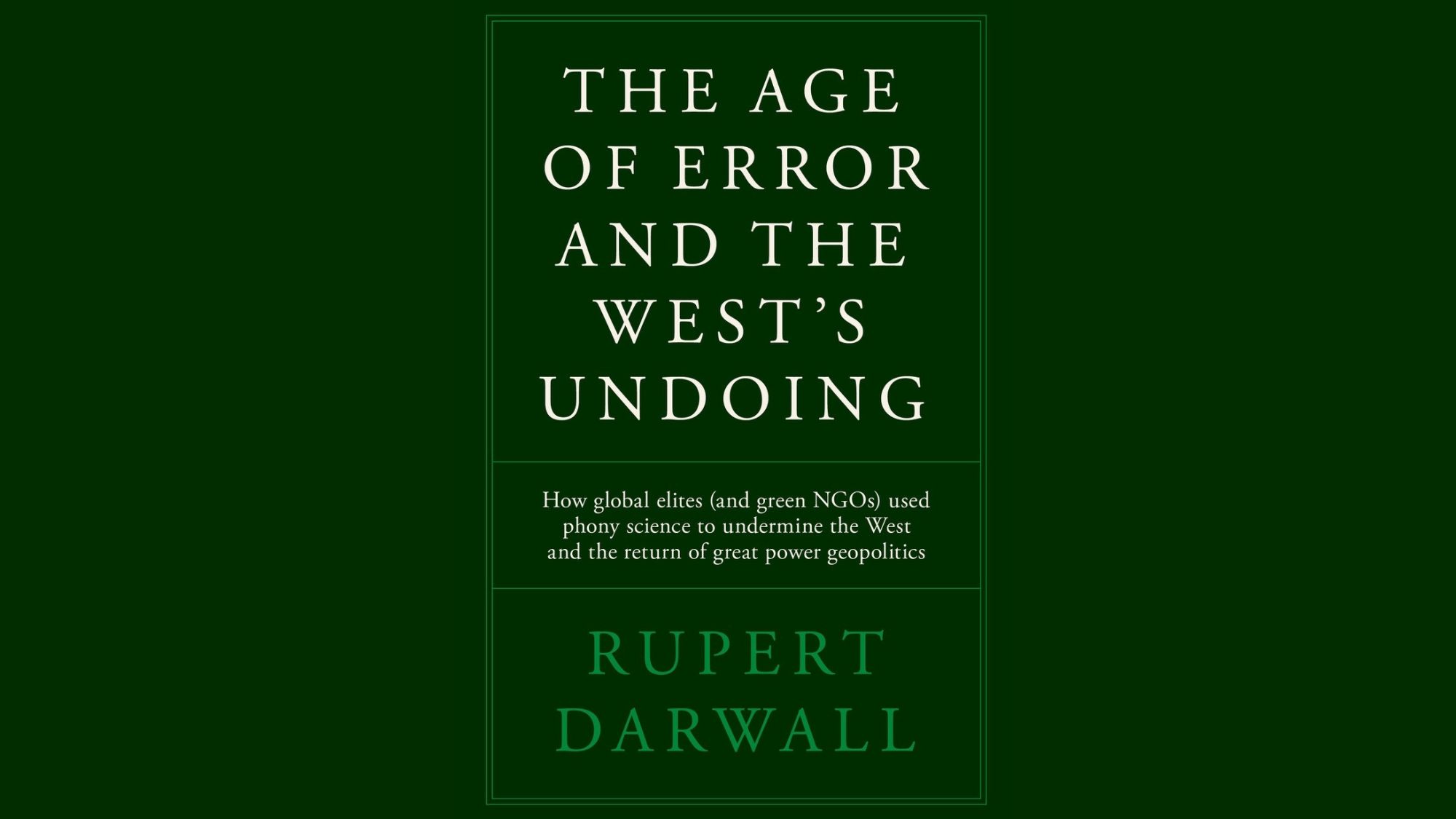
The Age of Error and the West’s Undoing argues that, after the 2008 financial crisis, Western leaders ceded authority to unelected experts and locked their economies into decarbonization commitments that weakened energy security, defense, and growth just as great power geopolitics returned.
Washington D.C. – November 2, 2026 – The National Center for Energy Analytics (NCEA) today announced the publication of The Age of Error and the West’s Undoing: How Global Elites (and Green NGOs) Used Phony Science to Undermine the West and the Return of Great Power Geopolitics by Rupert Darwall, senior fellow at NCEA. Published by Encounter Books, the 482-page work examines the transformation of Western politics between the 2008 financial crisis and Russia’s 2022 invasion of Ukraine, and argues that the West’s retreat from affordable, reliable energy was a choice with strategic consequences.
Darwall’s account begins in 2006, when G8 leaders still treated abundant energy as essential to growth and national security. After the financial crisis, he contends that realism gave way to green Keynesianism, ultra-low interest rates, ESG investing and an escalating commitment to climate policy. As elected leaders lost legitimacy, governing authority shifted to central bankers, climate scientists, public-health officials and global institutions, producing a form of technocratic governance in which policies presented as scientific truth were insulated from well-grounded criticism, democratic scrutiny, economic trade-offs and geopolitical reality.
Darwall’s book charts the period from the 2009 Copenhagen climate conference through the Obama administration’s climate partnership with China to the 2015 Paris Agreement, when a coalition of green NGOs and small island states impaled the West on the hook of net zero..
Summary of Key Arguments:
- Climate policy as elite therapy. After the financial crisis, Western leaders outsourced economic policy to central bankers so that they could concentrate on saving the world from climate change, while neglecting energy security, economic growth and geopolitics.
- Net zero and national security are in conflict. Europe is incapable of generating the resources needed for its own security, or serve as a credible security partner to the United States for as long as it remains committed to net zero.
- The EU as a Paper Empire. Darwall contends that the EU is the greatest geopolitical contradiction in the world in wanting to be a super-power rival to the US as the same time depending on the US for its security.
- Brexit and net zero. As Britain prepared to leave the EU, it swapped the yoke of EU membership, which had some economic benefits, for net zero, which has none, thereby ensuring that voters would perceive Brexit as a failure.
- The Ukraine test. On the eve of Russia’s invasion, American diplomats briefing their European counterparts on the coming war found them preoccupied with debating climate change. The war exposed a Europe that had spent a decade appeasing Russia and cutting defense budgets.
- Strategic dependence on China. Net zero deepens Western reliance on America’s chief geopolitical rival for the materials and manufacturing the energy transition requires.
- Experts over voters. From monetary policy to pandemic response, authority claimed under “follow the science” weakened democratic accountability and on climate change and Covid-19 led to systematic censorship which, in Darwall’s telling, enabled the cover-up of the pandemic’s origins.
- America’s divergence. The fracking revolution, the energy demands of artificial intelligence and the Trump administration’s rejection of net zero have put the United States on a divergent growth path from Europe and Britain.
“The Age of Error and the West’s Undoing” delineates the fundamental conflict between environmentalism and its claim that the threat of climate catastrophe transcends geopolitics and the reality that geopolitics - the rise and fall of great powers - never went away,” said Rupert Darwall. “If Western elites continue to subscribe to climate catastrophism, the book warns they will doom the West in the arena of geopolitics.”
Darwall has authored two previous books, Green Tyranny and The Age of Global Warming, as well as numerous think-tank reports. He was previously a senior fellow of the RealClearFoundation, worked as an investment analyst and in corporate finance, and served as a special advisor to the UK’s Chancellor of the Exchequer. His writing has appeared in the Wall Street Journal, The Hill and the Daily Telegraph, among others.
The Age of Error and the West’s Undoing (Encounter Books, hardcover, 482 pages, ISBN 978-1-64177-467-3) is available now from Encounter Books and major booksellers. To arrange an interview with Rupert Darwall, contact NCEA@melrosepr.com.
About the National Center for Energy Analytics
The National Center for Energy Analytics is a think tank devoted to data-driven analyses of policies, plans, and technologies surrounding the use and supply of energy essential for human flourishing. Through objective analyses of energy policies and their implications, NCEA aims to inform policymakers, industry leaders, and the public on critical energy issues.
###
Media Contact
Melrose PR | NCEA@melrosepr.com
